Changelog

  1. Glossary

    A new glossary explains every Logical Thinking Process term and acronym you meet in the guide, the books and the skills' output — CRT, UDE, injection, evaporating cloud and the rest — each under its own heading so it can be linked to directly, with a small sketch of each tree worked through one running example, e.g. reasoncommons.com/glossary#current-reality-tree.

  2. Reasoning diagrams drawn in the chat

    In the Claude apps, the reason-commons skill now draws each turn's change-status diagram as a rendered Mermaid flowchart inside the conversation, with proposed links dashed and accepted, proposed and disputed nodes outlined in different colours. Terminals and other plain-text chats keep the ASCII diagrams.

  3. Track the last reasoning change at a glance

    Reasoning sessions now put an ASCII status card above the direction choices to summarize the latest proposal, acceptance, dispute, or lack of change, and the final view choice lists available trees with node counts and a direct prompt for viewing one.

  4. Skills README you can hand to a colleague

    skills/README.md now leads with a simple installation path and copy-and-paste prompts for both conversational reasoning and source-to-project conversion. It explains that reason-commons is a candidate successor to ltp-project, while ltp-project remains the route to an app-importable file and ltp-visualize still needs a clone of this repository. ltp-project no longer asks for an app checkout to validate its output; it labels the file unvalidated instead, and a standalone check is tracked as a follow-up.

  5. Open reasoning diagrams without installing a renderer

    The reason-commons skill now generates standalone HTML diagrams with inline SVG, so accepted trees open in a browser without Graphviz, Node, or a Mermaid renderer.

  6. Build trees together and see what changed

    The new reason-commons skill helps individuals and groups develop Thinking Process trees through concise conversations, retaining contributors' ideas and unfinished reasoning. Explicitly accepted changes now preserve a numbered snapshot and produce two diagrams: the accepted tree and its latest changes, with earlier wording and removed connections visible for review.

    Sessions offer labeled choices to refine the reasoning, explore difficulties, capture another thought, or view the tree, with a compact status line showing the driver, other participants, and current focus. Tree requests include clearly labeled proposals so the reasoning is visible before anything is accepted. Natural review checkpoints now invite users to test, revise, continue developing, or provisionally accept a coherent proposal.

    Collaboration sessions now resume through the existing Beads handoff, with outstanding reasoning linked to work items and task completion kept separate from endorsement.
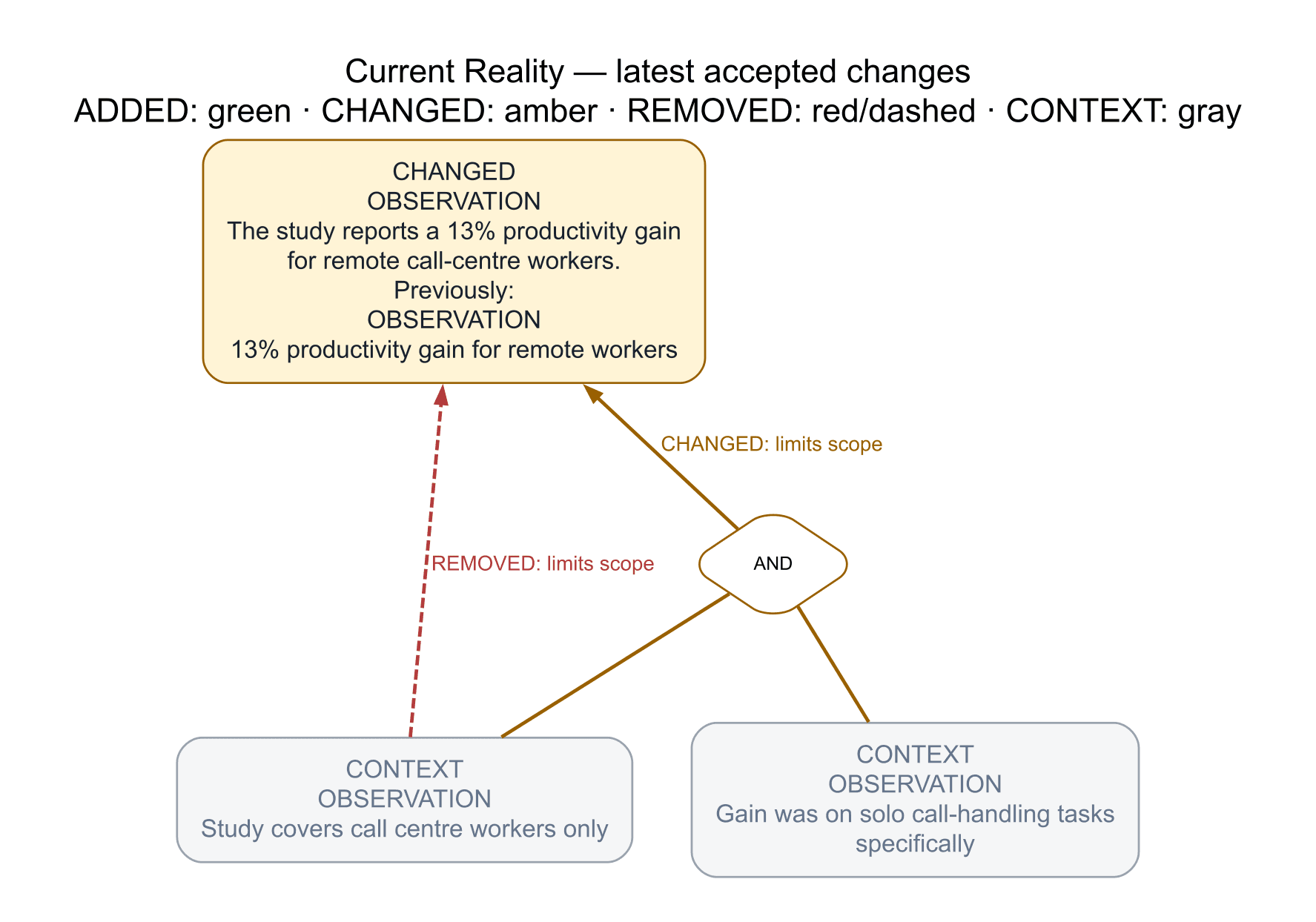
    A remote-work toy example shows revised wording in amber, the old connection in dashed red, and unchanged neighboring observations in gray.
  7. See the Current Reality causal graph on opening

    Standalone LTP previews now open with the Current Reality tree expanded, showing the source's causal links and feedback loops immediately while leaving disconnected observations separate.

  8. Preview LTP project files in the dashboard

    You can now export an .ltp.yaml candidate as a standalone HTML dashboard and open it directly in the browser with the ltp-visualize skill. A local-server preview is available too; neither path changes the candidate or imports it into a Reason Commons space.

  9. Future updates signup

    The Reason Commons landing page’s future-updates signup

    The landing page now offers a low-volume way to register interest in future Reason Commons updates. It records the request without starting a newsletter or sending email.

  10. The project has a model of itself, and NEXT.md is read off it

    ltp/reason-commons/reason-commons.ltp.yaml is Reason Commons — the group developing the app — as one Logical Thinking Process model in the interchange format the app imports, written with ltp-project from the app repository's docs and features, this repository's own statements of purpose, and every open issue here. All seventeen open issues sit in its transition tree with the need and expected effect their authors stated; the report beside it says where each landed and why, what the model does not claim, and which calls are still a person's. It is a candidate until ratified in the Reason Commons commons; the folder is kept off the published site because the reviewing surface for a candidate is GitHub. NEXT.md is now generated from the model's transition tree by the app repository's bun scripts/next-from-ltp.ts — actions nothing precedes first, then the rest in the order their links give — so what to do next is a consequence of the reasoning rather than a second list.

Built with LogoFlowershow